SaaS
The Real Cost of Standing Still: What the 2026 Numbers Say About Build, Buy, or Embed
Sep 11, 2026

Generative AI usage among small businesses jumped from 23% in 2023 to 58% in 2025, according to the U.S. Chamber of Commerce, the fastest technology uptake the Chamber has tracked since the rise of social media.
Zoom in on marketing specifically and the picture holds: 54% of small businesses already use AI marketing tools day to day, with another 27% planning to adopt within the next twelve months. That's not a slow, optional shift anymore. It's a category that moved from early-adopter territory to default expectation in under three years, and it's forcing a decision that a lot of BPMs and CRM providers have been able to defer until now: build the marketing layer in-house, buy a collection of point solutions, or embed a ready-made engine under your own brand.
If your platform is still debating that question, this is the environment the debate is happening in, and the underlying economics have shifted meaningfully in the last year alone. This isn't a call to panic into a decision. It's a call to look honestly at what building, buying, and embedding actually cost in 2026, because the gap between those three paths has widened in ways that change which option makes sense for most platforms.
Why the Math Changed
Three things moved at once, and together they explain why standing still now carries more risk than it used to.
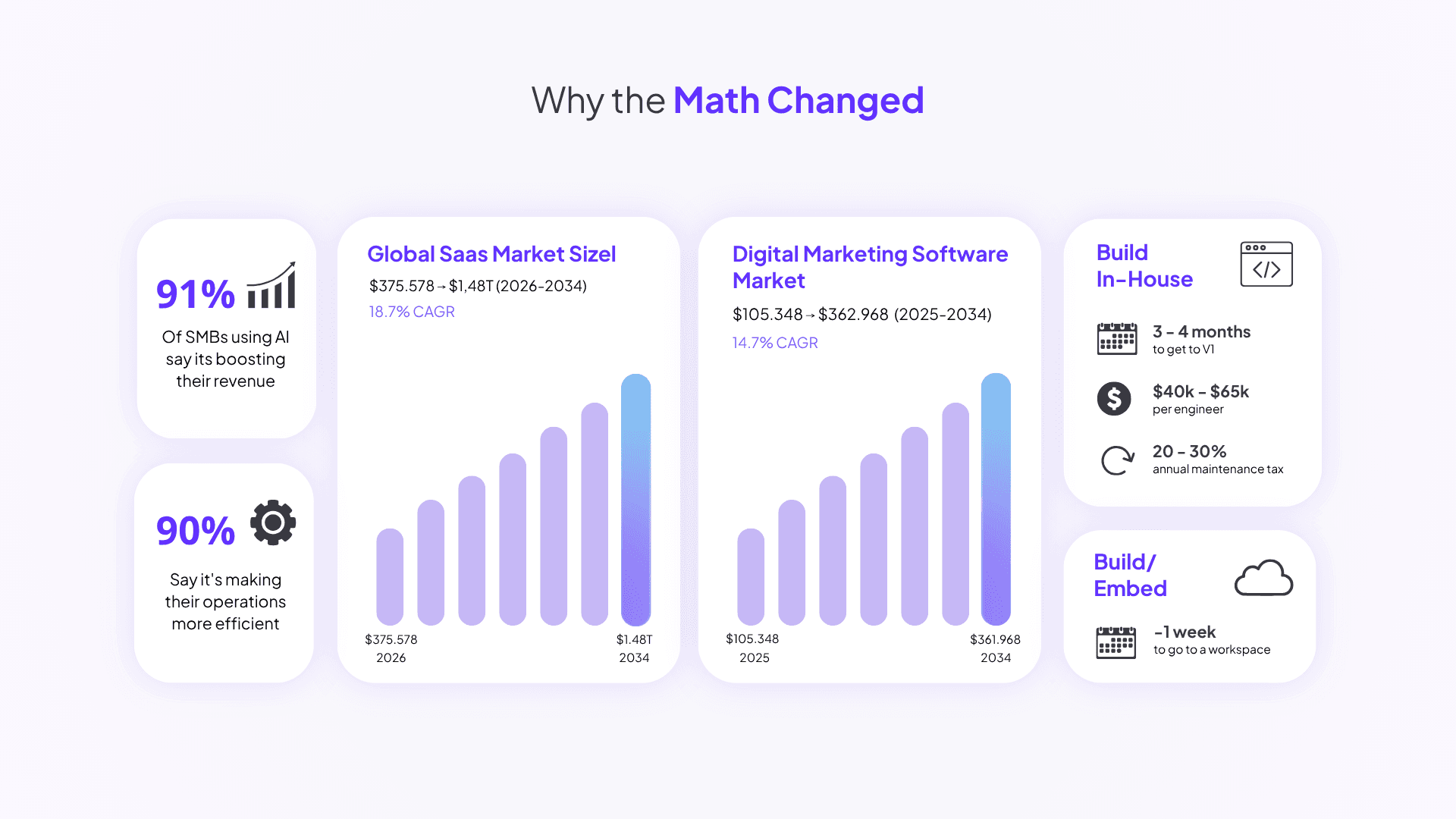
First, SMB expectations reset. When 91% of SMBs using AI say it's boosting their revenue and 90% say it's making their operations more efficient, AI-assisted marketing stopped being a premium feature and became a baseline expectation. A platform without some form of AI-assisted marketing in its offering is now explaining an absence, not offering a differentiator.
Second, the broader market grew underneath everyone. Fortune Business Insights projects the global SaaS market will grow from $375.57 billion in 2026 to $1.48 trillion by 2034, a CAGR of 18.7%. The digital marketing software category specifically is tracking its own fast trajectory: $105.34 billion in 2025, growing to $120.82 billion in 2026 and a projected $361.96 billion by 2034, a 14.7% CAGR, according to Straits Research. A category growing that fast attracts more entrants every quarter, which raises the bar for what "competitive" looks like even for platforms not actively watching the space.
Third, and most concretely for anyone weighing build versus buy, the cost of building and maintaining software in-house has become easier to quantify, and the numbers are not favorable to building from scratch unless a platform has genuinely unusual requirements.
Industry data on comparable embedded software builds shows the pattern clearly: a credible, customer-ready v1 built in-house typically takes 3 to 4 months of focused engineering time, roughly $40,000 to $65,000 in fully loaded salary for one engineer, before counting a 20 to 30 percent annual maintenance tax on top of that build every year afterward.
Buying or embedding a comparable capability, by contrast, can reach a first working workspace in about a week. Those particular figures come from embedded analytics specifically, but the underlying pattern, a multi-month build versus a matter of days to embed, plus a recurring maintenance tax that rarely shows up in the initial estimate, generalizes closely to embedded marketing tooling, where keeping pace with AI model updates, compliance requirements, and channel integrations creates the same kind of ongoing burden.
What This Signals for Platforms Weighing Their Options
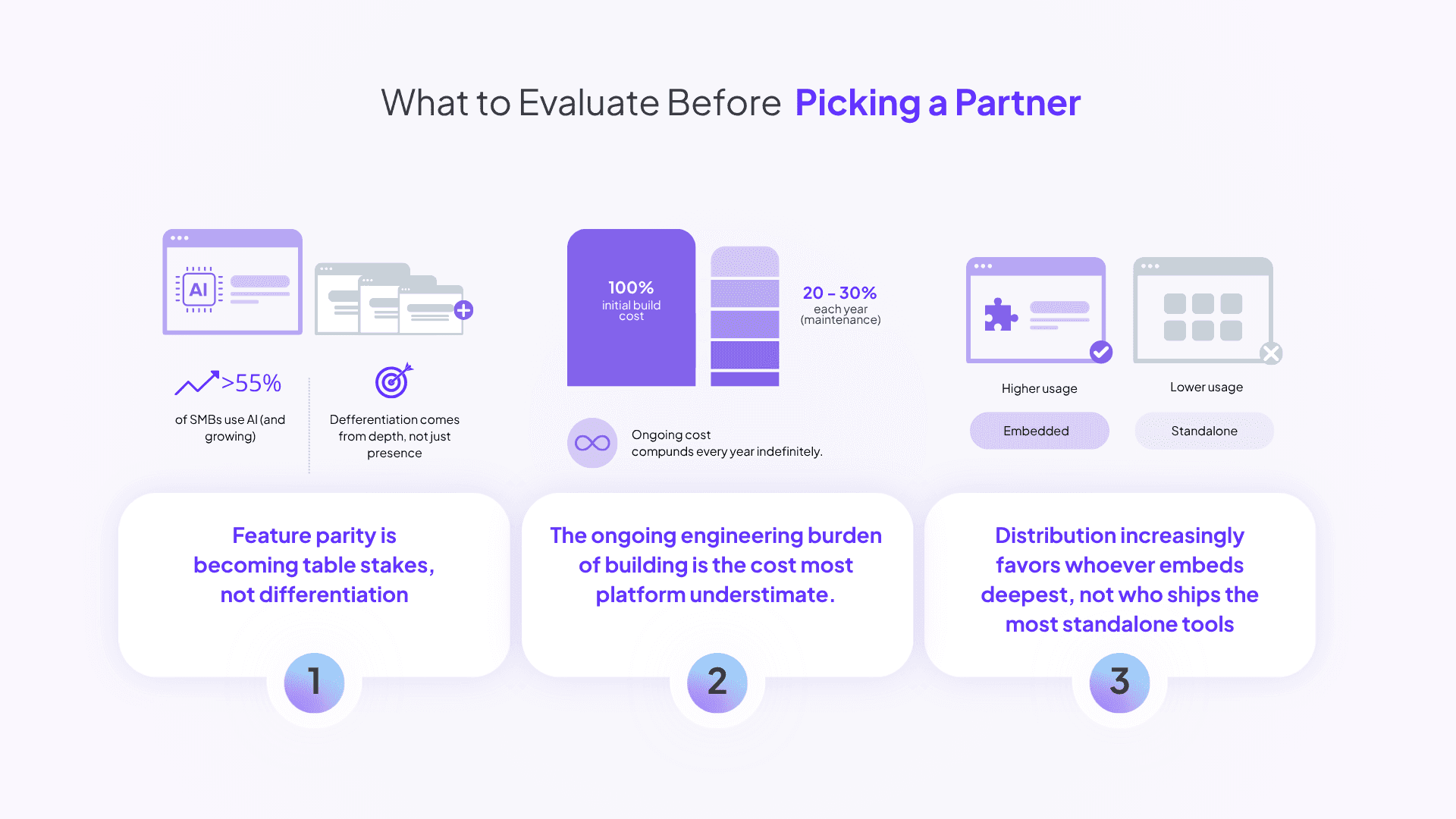
Feature parity is becoming table stakes, not differentiation. With generative AI use among small businesses now above 55% and climbing fast, simply having an AI-assisted marketing feature is no longer a pitch on its own. Every serious competitor in the white-label space already has some version of one. The differentiation has shifted to depth: how well the tool understands a specific business's data, how much of the workflow it handles without a human prompting every step, and how tightly it's embedded into a platform's existing product rather than bolted on as a separate login.
The ongoing engineering burden of building is the cost most platforms underestimate. Comparable build-versus-buy data across embedded software categories consistently shows a maintenance tax of 20 to 30 percent of the original build effort, every year, just to keep an in-house build current with model updates, integrations, and compliance changes, a cost that persists indefinitely and rarely gets fully priced into the original build decision. That ongoing burden compounds every year a platform stays on the build path, while a bought or embedded solution shifts that maintenance cost to the vendor instead.
Distribution increasingly favors whoever embeds deepest, not who ships the most standalone tools. The pattern across white-label and embedded software categories is consistent: platforms that fold a capability directly into an existing workflow, so completely that the end user stops thinking of it as a separate product, tend to see materially higher usage than platforms offering the same capability as a bolt-on tool requiring a separate login. For a BPM, that's the practical argument for embedding over stitching together standalone point solutions, even when the point solutions are individually well-built.
Considering what this means for your own roadmap? A quick look at where your current marketing stack sits against this data is worth doing before your next planning cycle, not after it. Let's talk through what your platform's actual build-versus-buy math looks like today.
Build, Buy, or Embed
Every BPM and CRM provider eventually runs this calculation, and the inputs have changed meaningfully in the last twelve months.
Building an in-house AI marketing suite that keeps pace with a market growing in the double digits annually is no longer a matter of a few quarters of engineering time. It's an ongoing, compounding commitment measured in years of dedicated engineering capacity, competing for the same headcount and roadmap space as the platform's actual core product.
Our Marketing Decision Matrix breaks down this evaluation in more depth, but the short version in 2026 is straightforward: the cost of standing still, or of building slowly while the category moves fast, has gone up, and it keeps climbing every quarter the market keeps growing at its current pace.
Buying point solutions and stitching them together has its own hidden cost that doesn't show up on a vendor comparison spreadsheet. Every additional vendor is another login, another support relationship, another integration that can break, and another place where the SMB customer's experience can fall apart in ways that reflect on the BPM's brand rather than the vendor's. Platforms that tried the stitched-together approach over the last two years are, in our conversations with prospective partners, increasingly the ones now looking to consolidate down to a single embedded partner instead, largely because the operational overhead of managing five vendor relationships turned out to cost more than the platform saved by avoiding one committed partnership.

What to Evaluate Before Picking a Partner
Speed to production-ready. Weeks to launch a branded marketing suite, not the multi-year build cycle an in-house team would need to reach current market capability. Ask any prospective vendor for a real production timeline with reference customers, not a roadmap slide.
Whether the AI is actually differentiated, or a wrapper. Ask what proprietary data or model tuning underlies the vendor's AI. A thin layer over a general-purpose model will fall further behind every quarter this category continues growing at its current rate, and the gap will be obvious to your SMB customers within a few months of use.
Compliance and brand safety built in, not bolted on. As AI-generated content scales across thousands of SMB accounts, quality and compliance controls need to be part of the product from day one, not an afterthought added post-launch after something has already gone wrong.
Pricing that scales with your business, not against it. As the white-label software category continues growing, make sure whatever partner you choose isn't pricing you out of the margin that makes reselling worthwhile in the first place, particularly as usage and account volume increase.
The platforms that treat this as a one-time decision are already behind the ones treating it as a standing question, revisited every quarter as the underlying market data shifts. The SMB customers both groups are trying to serve are noticing who keeps up and who doesn't, whether or not that shows up in a headline announcement.
Ready to see how an embedded, white-labeled marketing engine stacks up against building this in-house? Let's talk about where your platform actually stands today, using your own numbers rather than industry averages.
Sources: