SaaS
Scaling Embedded Marketing Across Multi-Location and Franchise Accounts
Sep 11, 2026

Sixty-five percent of new franchise leads now originate online before a prospect ever calls a location directly, and 72% of franchise systems put 40% or more of their marketing budget into local SEO specifically.
That's a meaningful share of spend concentrated in a category most embedded marketing tools still treat as an afterthought: a single-location feature set stretched across accounts that actually need something structurally different from the ground up.
For BPMs and CRM providers with franchise or multi-location customers already on the platform, that gap is a growth opportunity most competitors haven't built for yet, and it's one that's easy to underestimate until you look closely at how much budget concentrates in this segment relative to its share of total accounts.
The size of that opportunity is worth dwelling on, because it's not a niche corner of the SMB market. Franchise and multi-location brands represent a disproportionate share of marketing spend relative to how many individual accounts they actually are, which means a platform that gets multi-location support right isn't just adding a feature. It's positioning itself to win a segment of customers that spends meaningfully more per account than the single-location SMBs most embedded marketing tools were originally built around.
The Data Behind the Opportunity
Franchise and multi-location brands that run a dedicated local marketing strategy see meaningfully different outcomes than those that don't: 94% of top-performing multi-location brands maintain a dedicated local strategy, compared to roughly 60% of the broader field.
That gap alone should tell platforms something about where the ceiling is for accounts still being served generic, single-location tooling. Consistency compounds that advantage further: locations with accurate, matching name-address-phone (NAP) data across directories see 1.4 to 2.0 times the engagement of listings with inconsistent data, a problem that scales in difficulty with every additional location added to an account rather than staying flat.
Google Business Profile management alone accounts for roughly 32% of local ranking weight, and businesses that rank in the local 3-pack see 126% more traffic than those that don't. It's little surprise that 76% of franchise marketers now rate GBP management as their most valuable local marketing activity, ahead of paid advertising, email, and most other channels combined.
Taken together, these numbers describe a segment where the tooling gap has a direct, measurable cost. Every location with drifting NAP data or an unmanaged Google Business Profile is leaving traffic and ranking position on the table, and at franchise scale, that cost multiplies across every location rather than staying contained to one account.

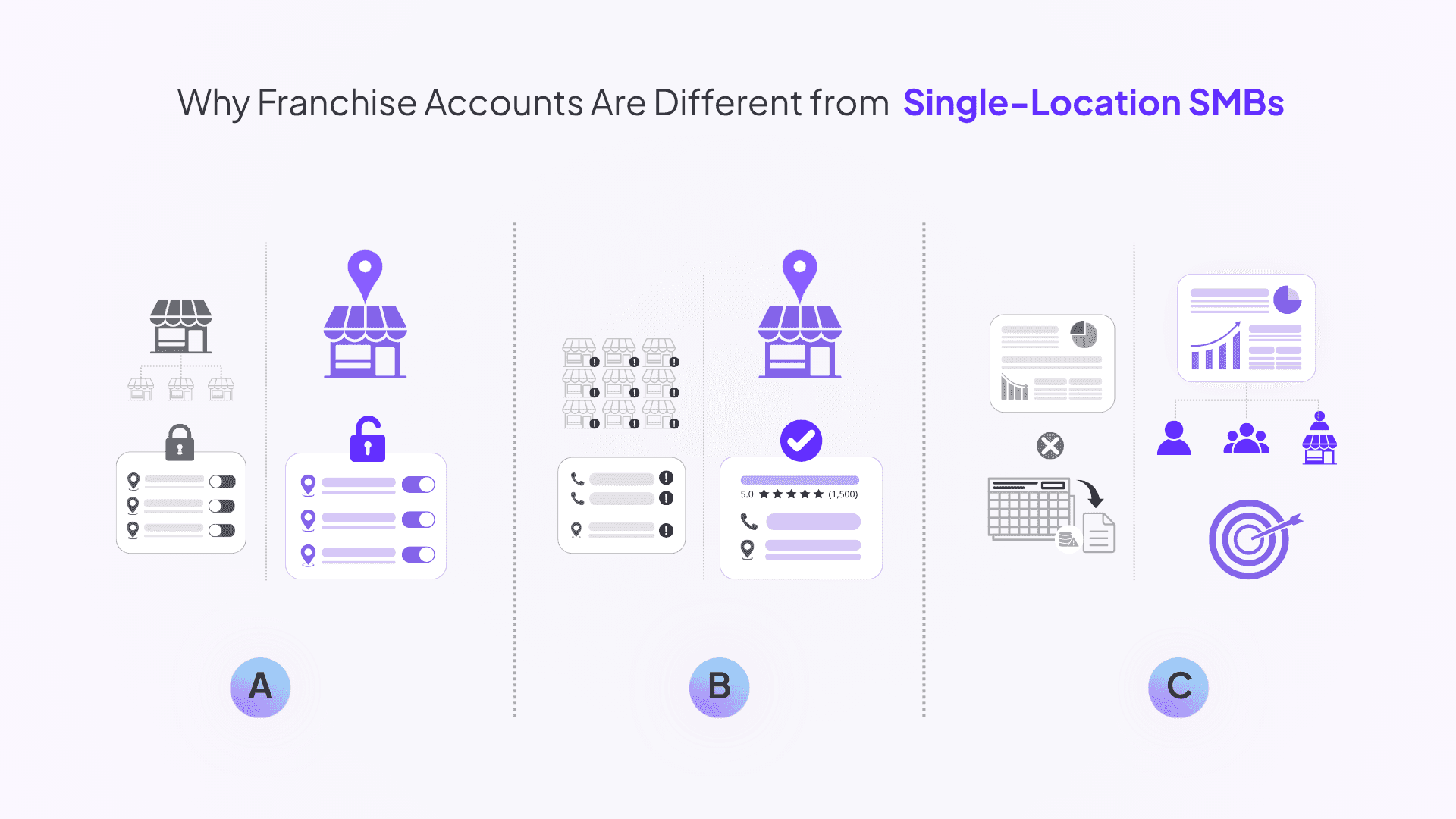
Why Franchise Accounts Are Different from Single-Location SMBs
A. Corporate brand standards versus franchisee autonomy. Corporate marketing teams need consistent messaging and brand compliance across every location, while individual franchisees often want, and are contractually permitted, some local control over their own listings and campaigns.
A platform built for single-location SMBs has no concept of this tension. It either locks everything down, frustrating franchisees who need local flexibility, or opens everything up, creating brand inconsistency that corporate marketing teams won't tolerate for long.
B. NAP consistency at scale. One location with an outdated address or phone number is a minor fix that takes a few minutes to correct.
Fifty locations with drifting, inconsistent listing data across directories is a structural SEO problem that compounds with every new location added, and manual cleanup simply doesn't scale past a handful of accounts before it becomes a full-time job for someone on the corporate marketing team.
C. Reporting that rolls up without flattening. Corporate stakeholders need aggregate performance across the full footprint to make budget decisions.
Regional managers need visibility into their specific territory to manage local performance. Individual location owners need their own numbers to understand how their location is doing on its own terms. A tool built for one location per account can't produce any of these views without significant manual workarounds, usually involving someone exporting and stitching together spreadsheets by hand every reporting cycle.
Wondering whether your current platform can actually support a franchise account the way corporate marketing teams expect? It's worth a direct look before your next multi-location deal closes, not after you've already made promises during the sales process.
What an Embedded Marketing Layer Needs to Support Multi-Location
The platforms winning franchise and multi-location accounts aren't just running the same single-location toolset more times across more accounts. They're building for the specific mechanics of the category: brand-compliant templates that still allow local customization within clearly defined guardrails, bulk NAP management that catches drift automatically rather than requiring manual audits per location, and reporting that rolls up cleanly from individual location to region to corporate without losing the detail any one stakeholder actually needs to do their job. That combination is genuinely hard to build well, which is exactly why it's still a competitive gap rather than table stakes across the category.
There's also an operational dimension that's easy to overlook: onboarding. A single-location SMB can be onboarded in an afternoon. A fifty-location franchise account needs a process that can add locations in bulk, apply brand standards consistently across all of them from day one, and give corporate visibility into rollout progress without requiring someone to manually configure each location one at a time.

What to Look For Before Committing to a Multi-Location Offering
Can brand guardrails and local customization coexist? A platform that forces an all-or-nothing choice between corporate control and franchisee flexibility will lose deals to one that offers both, because franchise systems increasingly expect this balance as a baseline requirement rather than a nice-to-have.
Is NAP consistency actively monitored, or manually maintained? At more than a handful of locations, manual listing management stops scaling entirely. Automated consistency checks aren't optional at franchise scale, they're the difference between a usable product and one that generates support tickets every time a location's information drifts.
Does reporting actually roll up, or just export per-location? A stack of individual location reports isn't the same as a corporate-level view built for the people making budget decisions across the whole footprint, and the gap between the two becomes obvious the first time someone tries to build a board deck from the data.
How fast can a new franchise account actually onboard? A platform that takes weeks to bring fifty locations online, one at a time, isn't built for this segment yet, no matter how good its single-location feature set looks in a demo.
Multi-location and franchise accounts represent a disproportionate share of marketing budget relative to their location count, and most embedded marketing tools still aren't purpose-built for the way these accounts actually operate day to day. The platforms that close that gap first pick up the accounts everyone else is currently underserving, and they keep those accounts longer, because switching a fifty-location franchise system to a new platform is a much bigger decision than switching a single-location SMB.

Sources:
BizIQ.
Vendasta's Franchise SEO guide.